Healthy AI First · Episode 5 · 18 min
The Right Medium
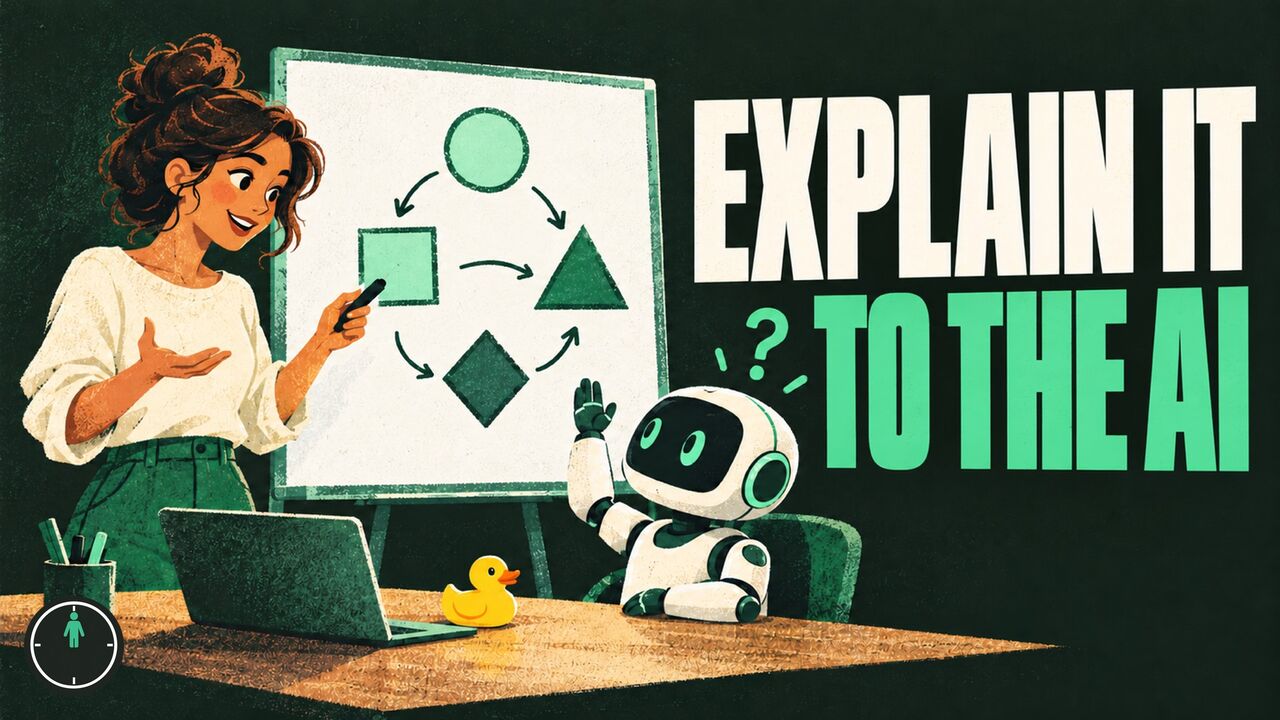
Miriam, the team lead, read a 12-page AI-written concept twice and still can't find the answer when Daniel asks in a meeting what happens if a payment notification arrives twice. This episode is about why a small diagram sometimes clarifies more than many pages of text, when duplicate explanations and voice help or hurt, and why explaining something to the AI yourself does more than just listening to it. With a rubber duck that asks back, a prompt to take away, and an experiment for developers and office work.
Listen on
Companion document
All studies, sources and claims from this episode in one PDF, to read along or look things up later.
Download the companion document (PDF)Chapters
- 0:00Cold Open
- 1:15Welcome
- 1:58Ten Thousand Words
- 3:12Map, Directions, Stranger
- 4:33A Picture for Your Ears
- 6:09When Pictures Hurt
- 7:23A word from us
- 8:15Double and Spoken
- 9:46Rereading Feels Good
- 11:01The Rubber Duck
- 12:15A Duck That Asks Back
- 13:44Miriam's Second Try
- 15:10One Picture Instead of Twelve Pages
- 16:09Your Experiment
Show notes
Take-aways
- Prompt for the understanding dialogue: "Ask me 3 questions about this change, one at a time. Wait for my answer after each question. And only at the end, tell me where I was wrong." Office version: "... 3 questions a critical colleague would ask about this document ..."
- Claude Code: switch the output style with
/output-style explanatoryor/output-style learning(Claude Code v2.1.269 or later), or run/configand select "Output style", or set"outputStyle": "Learning"in.claude/settings.local.json. Explanatory adds shortInsightblocks; Learning leaves aTODO(human)spot at real design decisions and waits for you. https://code.claude.com/docs/en/output-styles - Diagrams as text: GitHub renders Mermaid diagrams (for example
sequenceDiagram) in issues, pull requests, wikis and Markdown files. https://docs.github.com/en/get-started/writing-on-github/working-with-advanced-formatting/creating-diagrams
Studies and sources
Mentioned in the episode
- Larkin, J. H. & Simon, H. A. (1987): Why a Diagram is (Sometimes) Worth Ten Thousand Words. Cognitive Science 11(1), 65-100. Informationally equivalent diagrams and texts differ in computational effort: diagrams group information by location, save search and support perceptual inferences. https://doi.org/10.1111/j.1551-6708.1987.tb00863.x (free copy: https://mechanism.ucsd.edu/bill/teaching/F12/cs200/Readings/larkin.whyadiagramissometimesworth.1987.pdf)
- Roediger, H. L. & Karpicke, J. D. (2006): Test-Enhanced Learning: Taking Memory Tests Improves Long-Term Retention. Psychological Science 17(3), 249-255. Experiment 1: 120 students; after five minutes rereading was ahead (81% vs. 75%), after one week retrieval was ahead (56% vs. 42% of idea units). https://pubmed.ncbi.nlm.nih.gov/16507066/
- Chi, M. T. H., Bassok, M., Lewis, M. W., Reimann, P. & Glaser, R. (1989): Self-explanations: How students study and use examples in learning to solve problems. Cognitive Science 13(2), 145-182. Observational study, small sample. https://doi.org/10.1207/s15516709cog1302_1
- Chi, M. T. H., de Leeuw, N., Chiu, M.-H. & LaVancher, C. (1994): Eliciting self-explanations improves understanding. Cognitive Science 18(3), 439-477. Eighth graders, text on the circulatory system, 14 prompted to self-explain, 10 controls. https://doi.org/10.1207/s15516709cog1803_3
- Shen, J. H. & Tamkin, A. (2026): How AI Impacts Skill Formation. Preprint, callback to episode 1. https://arxiv.org/abs/2601.20245
- Stripe: Webhooks, section "Handle duplicate events" ("Webhook endpoints might occasionally receive the same event more than once."). Checked October 16, 2026. https://docs.stripe.com/webhooks#handle-duplicate-events
More on this (mentioned without names)
- Gravino, C., Scanniello, G. & Tortora, G. (2015): Source-code comprehension tasks supported by UML design models: Results from a controlled experiment and a differentiated replication. Journal of Visual Languages and Computing 28, 23-38. Students; the benefit depends on prior familiarity. https://doi.org/10.1016/j.jvlc.2014.12.004 . See also the aggregation of twelve experiments: Scanniello, G. et al. (2018), Empirical Software Engineering 23(5), 2695-2733. https://doi.org/10.1007/s10664-017-9591-4
- Brown, S.: The C4 model for visualising software architecture. A four-level notation from system context down to code; practical, no evidence of effectiveness. https://c4model.com/
- Ainsworth, S. (2006): DeFT: A conceptual framework for considering learning with multiple representations. Learning and Instruction 16(3), 183-198. Conceptual framework, not an effect study. https://doi.org/10.1016/j.learninstruc.2006.03.001
- Mayer, R. E. (ed.): chapter "Principles for Reducing Extraneous Processing in Multimedia Learning: Coherence, Signaling, Redundancy, Spatial Contiguity, and Temporal Contiguity Principles". In: The Cambridge Handbook of Multimedia Learning. Redundancy principle. https://www.cambridge.org/core/books/cambridge-handbook-of-multimedia-learning/principles-for-reducing-extraneous-processing-in-multimedia-learning-coherence-signaling-redundancy-spatial-contiguity-and-temporal-contiguity-principles/CD5B7AE1279A9AB81F8EEBB53DBEC86E
- Adesope, O. O. & Nesbit, J. C. (2012): Verbal Redundancy in Multimedia Learning Environments: A Meta-Analysis. Journal of Educational Psychology 104(1), 250-263. 57 independent studies, mostly university students: spoken plus written on average equal to written alone, better than spoken alone. https://doi.org/10.1037/a0026147
- Trypke, M., Stebner, F. & Wirth, J. (2023): Two types of redundancy in multimedia learning: a literature review. Frontiers in Psychology 14. 63 studies; content redundancy vs. modality redundancy, positive effects of content redundancy depend on prior knowledge. https://doi.org/10.3389/fpsyg.2023.1148035
- Kalyuga, S., Ayres, P., Chandler, P. & Sweller, J. (2003): The Expertise Reversal Effect. Educational Psychologist 38(1), 23-31. https://doi.org/10.1207/S15326985EP3801_4
- Leahy, W. & Sweller, J. (2011): Cognitive load theory, modality of presentation and the transient information effect. Applied Cognitive Psychology 25(6), 943-951. Two experiments with elementary school children (n = 24 and n = 64). https://doi.org/10.1002/acp.1787
- Agarwal, P. K., Nunes, L. D. & Blunt, J. R. (2021): Retrieval Practice Consistently Benefits Student Learning: a Systematic Review of Applied Research in Schools and Classrooms. Educational Psychology Review 33(4), 1409-1453. 50 experiments, 5,374 learners, 57% of effect sizes medium or large. https://doi.org/10.1007/s10648-021-09595-9
- Slamecka, N. J. & Graf, P. (1978): The generation effect: Delineation of a phenomenon. Journal of Experimental Psychology: Human Learning and Memory 4(6), 592-604. https://doi.org/10.1037/0278-7393.4.6.592
- Hunt, A. & Thomas, D. (1999): The Pragmatic Programmer. Addison-Wesley. Section on "Rubber Ducking" (explaining the problem to someone else). https://pragprog.com/titles/tpp20/the-pragmatic-programmer-20th-anniversary-edition/
Tools
- Anthropic: Claude Code documentation, Output styles (Explanatory with
Insightblocks, Learning withTODO(human)spots,/output-stylecommand). Checked October 16, 2026. https://code.claude.com/docs/en/output-styles - GitHub Docs: Creating diagrams (Mermaid in issues, pull requests, wikis, Markdown). Checked October 16, 2026. https://docs.github.com/en/get-started/writing-on-github/working-with-advanced-formatting/creating-diagrams
Foundation of the series
- Healthy AI First Software Development, version 2 (October 1, 2026), chapter 6 "Visual models and conversations" and chapter 1, finding 7 ("Active explanation deserves a trial"). The understanding dialogue and the diagram working rule are explicitly labeled as hypotheses there. The team agreement in the chapter "One Picture Instead of Twelve Pages" is a narrative proposal, not a study result.
Healthy AI First is AI-researched and AI-generated, narrated in Björn's voice, recreated with AI, and reviewed by him. Miriam, Daniel and Jonas are fictional characters.
Bringing AI into your team?
Björn is one of the founders of CLN Work. CLN Work helps companies adopt AI in small, verifiable steps: finding where real capacity is, which processes can be automated, and how to use AI interactively. The decisions stay with you.
Book a free 30-minute conversation